
Our autumn has kicked off with good energy, and there will be many inspiring things happening during the upcoming academic year. We will launch our new season of ELBOW Talks very soon, the programme of our ELBOW Conference in March 2026 will be published in December, and our researchers are travelling all around Europe gathering material for the research.
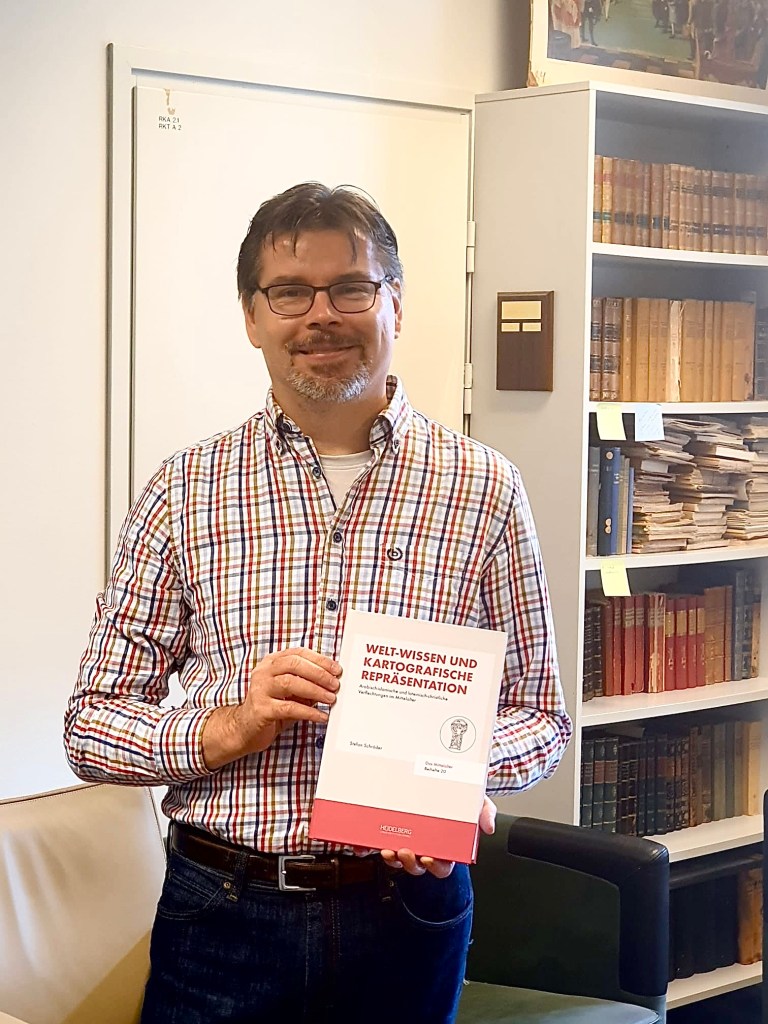
There is also great news we would love to share. Our researcher Stefan Schröder has published a new book he has been working or for almost two decades. The name of the book is Welt-Wissen und kartografische Repräsentation – Arabisch-islamische und lateinisch-christliche Verflechtungen im Mittelalter (2025, Heidelberg University Publishing). The book is open access, so we encourage everyone to have a look at it HERE.
The English abstract of the German publication is as follows:
This interdisciplinary study explores the controversially discussed question of whether and how geographical and cultural knowledge from the Arab-Islamic world was utilised by European mapmakers. The contextual analysis of cartographic representations – from diagrammatic maps of the three known continents and the seven climes to detailed world maps and Portolan charts – as well as accompanying source texts from the 10th to the beginning of the 15th century demonstrates the complex dynamics of the transmission of knowledge, which was neither linear nor continuous. Following the spatial turn, maps are understood as hybrid, socio-cultural cultural sources that conceptualise space and transmit cultural world views, which were used to pursue a variety of interests.
Last week Stefan presented his new publication among the colleagues at the University of Helsinki. Stefan told how it was ”good to have such little events for having these rare moments of reward after working on something for so long”. We could not agree more.
Congratulations Stefan, we are really proud of your work!
 Elbow
Elbow 
Jätä kommentti