

Our ELBOW researchers Stefan and Edna have been exploring the common ground of love and electricity, in the spirit of today’s Valentine’s Day. Inspired by the more or less surprising combination of love and electricity, we published yesterday the first part of two blogposts celebrating Saint Valentine.
Whereas in his text, Stefan deals with metaphorical and practical connections of love and electricity, Edna takes a look at this connection in the viewpoint of human sexuality.
Making love desirable and fertile with electricity
Electricity and love may seem like an odd pairing, but in actuality, electricity has from its earliest implementations been connected to sexuality and desire. This text examines the history of desire, virility and fertility, and how electricity was connected to all these different aspects of human sexuality.
Electricity, as the previous Stefan’s case demonstrates, carried an inherent connection to eroticism and the feeling body in the minds of 18th-century people, connecting both to sexuality and gender. This connection exhibited itself in works examining infertility and sexuality, another growing interest in the late 18th century.
Studying how electricity was used in the treatment of different sexual aspects of the body can tell us not only about medical electricity, but also about the gendered expectations and norms when it came to sexuality.
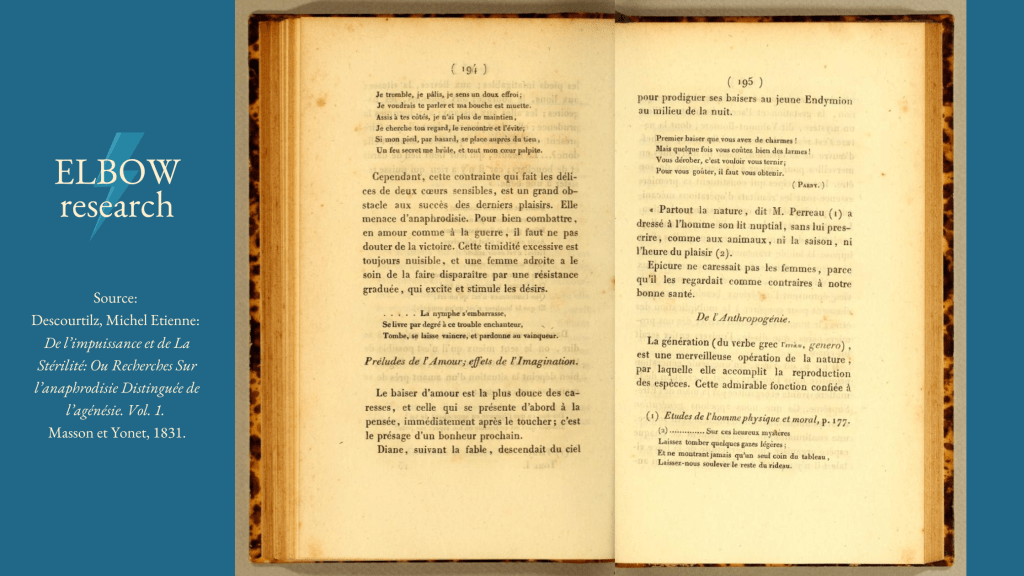
One of such cases can be found in the work by Michel Étienne Descourtilz, titled De l’impuissance et de la stérilité, : ou Recherches sur l’anaphrodisie distinguée de l’agénésie; ouvrage destiné aux personnes mariées qui ne peuvent avoir d’enfans from 1831.
This book attempts to both theoretically explain and offer viable treatments to different concerns and illnesses regarding sexual capabilities. Descourtilz himself was a French physician, who lived and worked in France as well as in Haiti, and this book has detailed accounts of infertility and other sexual difficulties both in France and in Haiti.
In this book, Descourtilz describes having used electricity exclusively on men, and as a tool in cases when other methods have failed, a typical statement in the suggestions of this fairly new treatment. Electricity was lumped together with other stimulating treatments like cold and hot baths, massages as well as flaggelation.
Descourtilz describes successful cases of medical electricity in cases of weakness or lack of virility, where electricity was applied to the perineum or the tip of the penis. The reason why Descourtilz does not see women as benefitting from electricity is because the perceived passiveness of women’s role in reproduction. This was an idea becoming more and more popular long the 19th century, especially after the discovery that women do not need to orgasm to get pregnant, something noted by Descourtilz as well.
But not only was electricity used to treat the lack of sexual virility, it was also used in cases regarding the excess of it. The concerns around masturbation and its downsides were not new, but got a new medical framework with Samuel Tissot’s widely cited work L’Onanisme (1760).
One of the people inspired by this work – and the idea of “wasted” virility that masturbation was thought to cause – was the French physician Francois Lallemand. He described treating erectile dysfunction, “involuntary ejaculation”, and masturbation with electricity.
Lallemand’s concern of, in particular, young men losing their virility and life force, by masturbating or having wet dreams, was shared by many at the time. Masturbation was thought to cause stupidity as well as a heightened risk to contract venereal diseases later in life. But, in the same vein, some of the cases treated by Lallemand were against erectile dysfunction.
The simultaneous concern of both sexual dysfunction, but also the condemnation masturbation, went to show the increasing interest in the sexual energy being released in the correct manner. There was a narrow window where the late 18th-century patient was exhibiting the right amount and the right manner of sexual activity.
These case studies of Lallemand and Descourtilz exemplify how sexuality and sexual behavior became increasingly a medical matter, a moral one. The implantation of medical electricity can be seen as bringing more legitimacy and an air of professionalism to a treatment as sensitive as sexual dysfunction or masturbation.
The question of why medical electricity was offered to only men is a complex one. It could also not be the whole truth, since the taboos around women’s sexuality and its treatment were much more significant, perhaps hindering some from writing about it. But that is a question for another day and perhaps another holiday!
Happy Valentines Day!
Author
Doctoral Researcher Edna Huotari
References
Bertucci, Paola: “Sparks in the Dark: The Attraction of Electricity in the Eighteenth Century”. Endeavour 31, No. 3, pp. 88–93. September 2007.
Descourtilz, Michel Etienne: De l’impuissance et de La Stérilité: Ou Recherches Sur l’anaphrodisie Distinguée de l’agénésie. Vol. 1. Masson et Yonet. 1831.
Dorlin, Elsa, and Grégoire Chamayou: “L’objet= X. Nymphomanes et Masturbateurs XVIII e-XIX e Siècles”. In Nouvelles Questions Féministes 24, No. 1, pp.53–66. 2005.
Fairclough, Mary: “Electrical Medicine, Feeling and Eroticism”. In Literature, Electricity and Politics 1740–1840: ‘Electrick Communication Every Where’, pp. 77–119. 2017.
Harvey, Karen: “The Century of Sex? Gender, Bodies, and Sexuality in the Long Eighteenth Century”. In The Historical Journal 45, No. 4, pp. 899–916. 2002.
Lallemand, François: Des Pertes Séminales Involontaires. Béchet jeune. 1836.
Laqueur, Thomas: Making Sex. 1990.
Tissot, Samuel Auguste David: L’onanisme Ou Dissertation Physique Sur Les Maladies Produites Par La Masturbation. De l’Imprimerie d’Antoine Chapuis, 1760.
Van Peene, Jacques Hubert: Dissertation Sur l’emménologie : Et Sur Les Maladies Les plus Communes Des Filles Pubères, Qui Ont Un Rapport plus Ou Moins Spécial Avec La Menstruation. Gent, 1815.
Zelle, Carsten: “Vernünftige Ärzte”: Hallesche Psychomediziner und die Anfänge der Anthropologie in der deutschsprachigen Frühaufklärung. Hallesche Beiträge zur europäischen Aufklärung 19. Tübingen: Niemeyer, 2001.
 Elbow
Elbow 
Jätä kommentti