
Followed by our Halloween blogpost last Autumn, we are continuing on the path of electricity and holidays. This time, our ELBOW team has been exploring the common ground of love and electricity, in the spirit of Valentine’s Day.
Our researchers Stefan and Edna have written their views on the subject, and this first published blogpost by Stefan deals with connections between love and electricity – both in metaphors and in practice.
Sparking love and electrical kisses
With the emergence of “fashion-science” electricity in the 18th century, the influence of electrical phenomena on common language grew stronger.
Metaphors such as ‘electrified’ and ‘struck by lightning,’ which describe a person’s emotional state or sudden behavioural reactions, were joined by phrases such as ‘a spark was lit,’ ‘there was a spark between them,’ and ‘there was a crackling tension between them’, as Peter Heering presents (2016).
The igniting spark as a metaphor for vibrant thoughts is e.g. echoed by Johann Wolfgang von Goethe, who owned several friction machines for experimenting with electricity. In a letter from 1769, he praised the vitality and courage of his friend Friederike Öser, writing, “Joy of the soul and heroism are as communicable as electricity, and you have as much of it as the electrical machine has sparks of fire in it”.
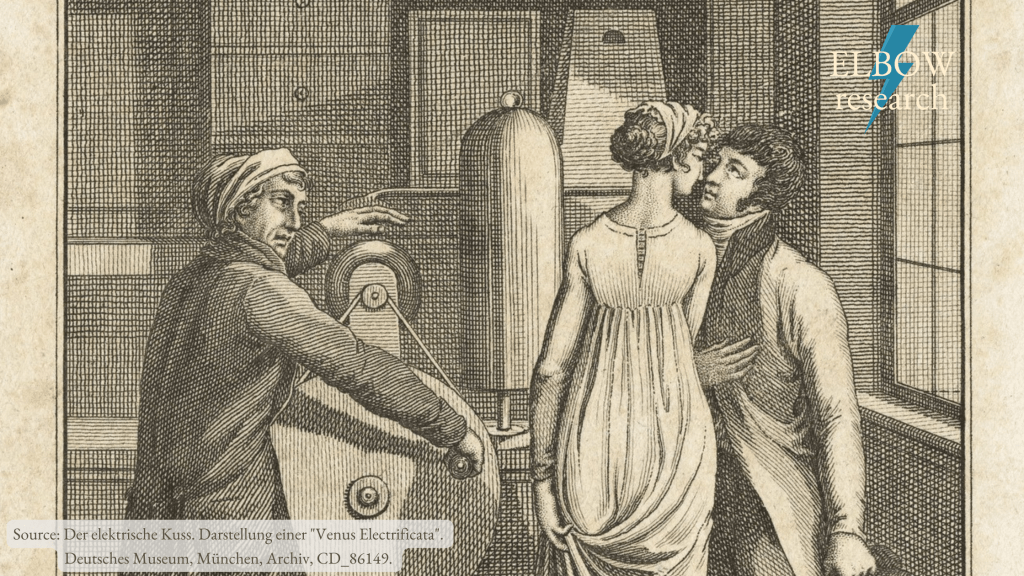
The other two metaphors refer to the romantic relationship of two people in love, rooted in the dualism of attraction and rejection in electricity – a concept that was gradually understood, not least through spectacular performances such as the electrical kiss, illustrated in the image below.

Deutsches Museum.
In this performative illustration, a woman standing on an insulating footstool was first charged electrostatically through a friction machine. Once this was achieved a man who typically did not suspect anything, was allowed to kiss the Venus electrificata.
Just before their lips touched, an electric spark was emitted, leading to an electric shock that surprised the man.
The idea for the setup stems from Georg Matthias Bose, who in his popular work Die Electricität nach ihrer Entdeckung und Fortgang mit poetischer Feder entworffen (”Electricity after its discovery and progress, sketched with a poetic pen”) from 1744 rhymed:
The waist resembles Venus. Where on the lips glow,
And rose and lily rest on chaste cheeks. […]
Such an enchanting, adorable child
Is electrified as swift as the wind. […]
If a mortal touches something with his hand
Even the garment of such a child of the gods,
The spark burns at once, and through all the limbs.
Painful as it was, he nevertheless tries again […]
Once more than once I tried, and took
Venus a kiss, but heavens, how I felt
such misguided courage. It seemed, a blaring stinging
almost twisted my mouth. The teeth wanted to break.
(Bose 1744, pp. 29-30 – translation by the author)
Often performed in salons in front of the nobility or the upper bourgeoisie, the celebrated godlike female body became an object of male desires and erotic fantasies. The pain associated with the electric shock served as a punishment for pursuing something that was forbidden, yet irresistible at the same time.
With the invention of the Leyden Jar in 1745 – an early battery capable of storing electricity and delivering stronger shocks – the sting could be indeed severe, as one of its inventors, Ewald Georg von Kleist (1700-1748), ironically noted in a letter: “I am sure that that with such violent sparks, Mr. N. N. would have been better off refraining from the repeated kissing with his Veneranda Venere.”
Despite such painful experiences, many authors of the Enlightenment Era employed electrical references as metaphors for erotic attraction. In the novels of E.T.A. Hoffmann (1776-1822), for instance, electric love is intertwined with impassioned and blind desire, reflecting the suddenly and erratically actions of lovers who are simultaneously attracted to and repelled of each other.
This dynamic serves to juxtapose or challenge the prevailing moral imperatives surrounding the notion of love as a rational and virtuous connection between two individuals. In Hoffmann’s Die Brautwahl (the Choice of Bride), a short novel first published in 1820, the plot unfolds a love story filled with twists and turns.
When the two protagonists finally confess their love for one another, Hoffmann pens: “As he entered, Albertine spoke very audibly: ‘Yes, Edmund! I will love you forever, forever!’ And with that, she pressed Edmund to her chest, and a whole firework of electric shocks, as described above, began to rush and crackle”.
Happy tomorrow’s Valentine’s Day!
Author
University researcher Stefan Schröder
References
Bose, Georg Matthias: Die Electricität nach ihrer Entdeckung und Fortgang mit poetischer Feder entworffen. Wittenberg 1744.
Gaderer, Rupert: ”Liebe im Zeitalter der Elektrizität. E. T. A. Hoffmanns homines electrificati”. In Österreichische Zeitschrift für Geschichtswissenschaft, Vol. 18, pp. 43–61. 2007.
Gaderer, Rupert: Poetik der Technik. Elektrizität und Optik bei E.T.A. Hoffmann. Freiburg i.Br. 2009.
Heering, Peter: ”Batterien aufladen und andere Metaphern in und aus der Elektrizitätslehre: Einige Anmerkungen”. In Metaphorik.de Vol. 26, pp. 39–59. 2016.
Hochadel, Oliver: Öffentliche Wissenschaft. Elektrizität in der deutschen Aufklärung. Göttingen 2003.
Hoffmann, E.T.A.: Die Brautwahl. Eine Geschichte, in der mehrere ganz unwahrscheinliche Abenteuer vorkommen. Berlin 2015, first published in 1820.
Krüger, Johann Gottlob: Geschichte der Erde in den allerältesten Zeiten. Halle 1746.
Specht, Benjamin: Physik als Kunst: Die Poetisierung der Elektrizität um 1800. Berlin, New York 2010.

 Elbow
Elbow 
Jätä kommentti