

It is time for our third case study, we hope you have enjoyed them so far! If there is any feedback or comments you would like to share with us, please let us know through email or our contact form.
The idea behind these case studies is that we would like to introduce to you the cases and materials our ELBOW research team is working with. So far you can find two blog posts about case studies, written by our ELBOW researchers.
Our first case study that we shared with you was about menstruation and a surgeon who treated the so-called ”obstructions” of menstruation using electricity. This case study belongs to materials our ELBOW researcher Annika Raapke is working with.
Our second case study involves beheaded bodies, electricity, and experiments that aimed at proving Galvanism correct. The case is studied by our ELBOW researcher Edna Huotari.
And now we are happy to share a case that our ELBOW researcher Stefan Schröder has been studying. In this case, the electricity was applied in a medical treatise method that promised ”medicine without medication”. Johann Gottlieb Schäffer was promoting the use of electricity in his books at the time when the actual impact of electricity on humans and animals was widely unknown.
Medicine without Medication
With the caption Medicina sine Medicatione (Medicine without Medication) underneath the copper engraving, Johann Gottlieb Schäffer (1720-1795) promoted medical electricity as a new therapy method.
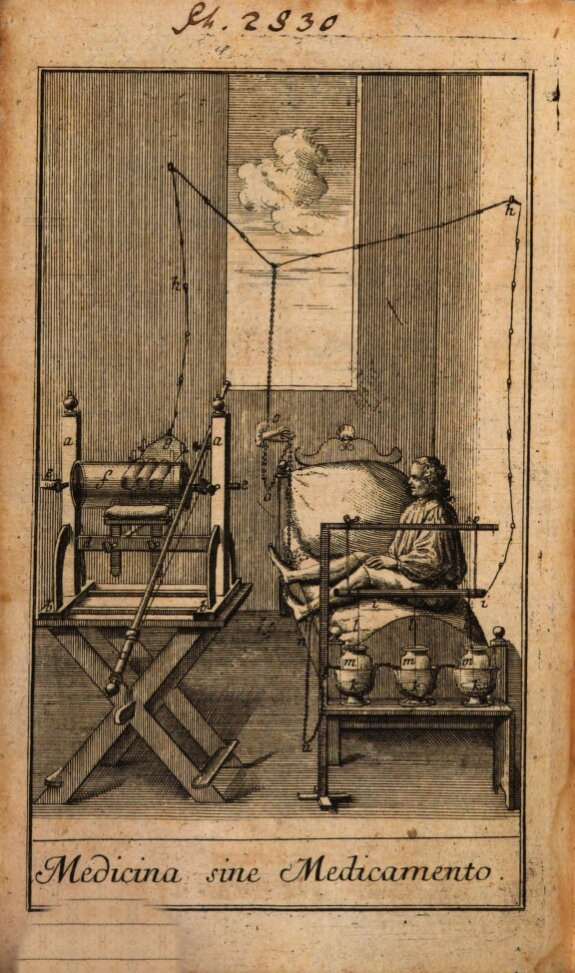
As the title of his treatise implies, it could be particularly helpful in cases of numb or petrified body parts. The title of his treatise says: “About the power and impact of electricity on the human body and its diseases especially concerning paralyzed limbs: reasonably explained and confirmed through experience”.
The engraving should give the spectators an imagination of how it is to be done. Through a little chain, the patient is connected to an electrostatic generator that was able to generate electricity through spinning a glass cylinder. Conducted through the chain, the electric oscillation was meant to be transferred to the body or some special parts and should help to ease hardenings and congestions through repeated sessions.
The treatise must have sound promising for readers. It promised that the patient can be treated while sitting more or less comfortably in a bed as the image without the need to take any other medicine such as bade-tasting pills and powders, or to go through some painful exercises. (According to Schäffer, in the image the patient is sitting only because of an artistically decision by the engraver – normally the patient would lie down.)
Schäffer’s text was published 1752 and hence one of the very early German texts on the topic when the actual impact of electricity on humans and animals was widely unknown. He argued that electricity would penetrate the whole body and reach all its inner parts, which he saw as an advantage to traditional medication. It would also improve the distribution of the fluid body parts, especially the blood circulation, and thus help to overcome certain afflictions.
While Schäffer was cautious to say that medical electricity could actually cure people and warned about the dangers of too strong discharges, the image nonetheless appealed to the hopes that were connected to medical therapy.
He published a second edition in 1766 in which he affirmed his experiences with medical electricity and provided more material. Again, a copper engraving is used to introduce the work. This time, however, it is way more sophisticated.
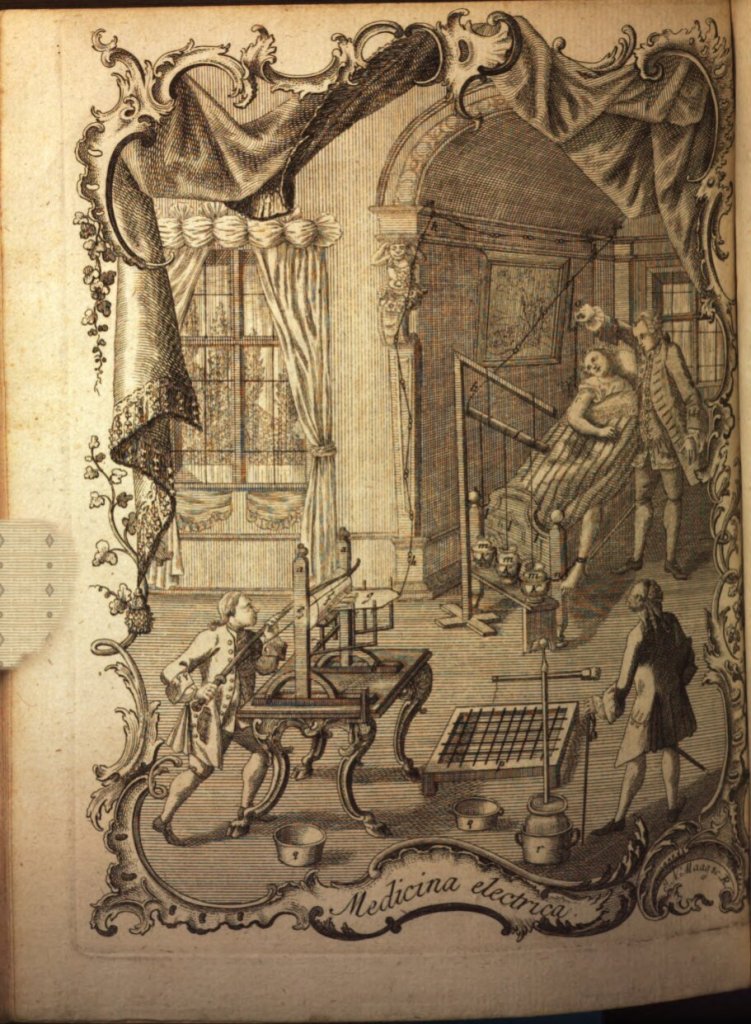
It shows the patient now lying in bed under a blanket. A supervising doctor connects the chain to the patient’s body who is electrified through the machine that is manually worked by an assistant. A third person is watching the procedure. The caption this time just speaks of Medicina electrica (medical electricity), but the arrangement gives the impression that it is a tested and safe procedure to treat sick people.
Schäffer was a medical doctor practicing from 1747 onwards at the city of Regensburg in South Germany. Later, he became also the personal doctor of the Princely House of Thurn and Taxis and first municipal medical officer of Regensburg.
Medical electricity, however, was not his only field of activity. He also published works on an apparatus to inhale tobacco for medical purposes and on a new method to treat cataract. As usual for many scholars at the time, he furthermore worked on a wide range of topics beyond medicine.
This included treatises on mollusks and insects (four beetle species are named after him), mushrooms and publishing an early reading and spelling book for children. He furthermore worked on optical instruments and tried to find new ways to produce paper with less expensive materials, so that books could be produced and sold cheaper.
Source material:
Schäffer, Johann Gottlieb: Die Kraft und Wirkung der Electricitet in dem menschlichen Körper und dessen Krankheiten besonders bei gelähmten Gliedern: aus Vernunftgründen erläutert und durch Erfahrung bestätigt. Regensburg 1752.
Schäffer, Johann Gottlieb: Die Electrische Medicin oder die Kraft und Wirkung der Electricität in dem menschlichen Körper und dessen Krankheiten besonders bey gelähmten Gliedern aus Vernunftgründen erläutert und durch Erfahrungen bestätiget. Regensburg 1766.

 Elbow
Elbow 
Jätä kommentti